
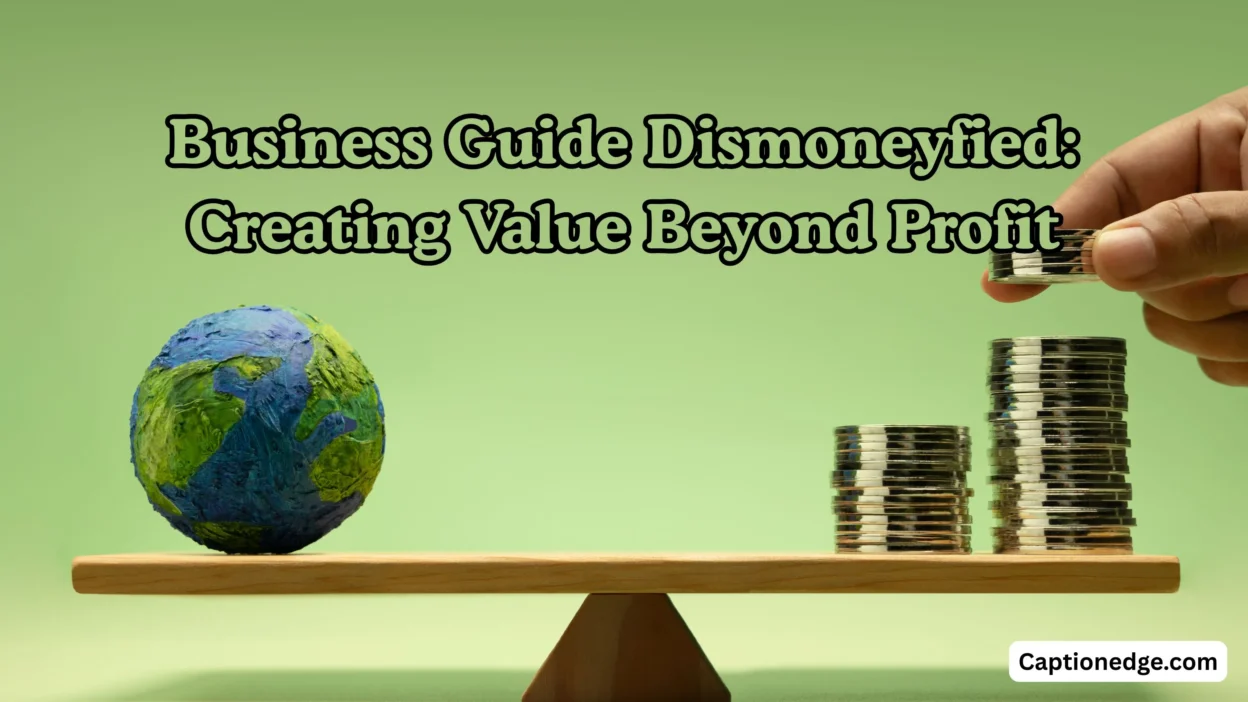
What if the primary scorecard for your business wasn’t its bank balance? Enter the concept of a dismoneyfied business. This doesn’t mean ignoring money—profit is essential for survival—but it means dethroning monetary gain as the sole, supreme objective. A dismoneyfied business builds its strategy around creating multidimensional value: for people, the planet, and purpose, using financial success as a fuel for this mission, not the finish line. This guide is your roadmap to integrating this powerful mindset into every facet of your company, creating a more resilient, meaningful, and impactful enterprise.
What Does “Dismoneyfied” Really Mean? Core Philosophy
“Dismoneyfied” is a mindset shift from profit-centric to value-centric operation.
- The Core Principle 🔄: It is the intentional process of de-emphasizing pure financial metrics as the primary drivers of decision-making and re-emphasizing holistic value creation.
- It is NOT Anti-Money: A dismoneyfied business is profitable and financially healthy. Money is seen as oxygen, not the reason for breathing. It enables the mission.
- The Value Spectrum: Value is measured across multiple capitals: Financial, Social, Intellectual, Human, and Natural Capital.
- The Ultimate Goal: To build a self-sustaining enterprise where profit is a byproduct of doing things right, not the only thing that’s right to do.
The “Why”: Pressures Fueling the Dismoneyfied Shift
Multiple powerful forces are making this shift from a nice-to-have to a strategic imperative.
- Consumer & Talent Demand 🧑💼: Modern customers and employees seek alignment with their values. They support and work for companies that stand for something more.
- Investor Evolution: The rise of ESG (Environmental, Social, and Governance) investing and impact capital proves that a portion of the market values sustainable, ethical growth over short-term extraction.
- Regulatory & Risk Landscape: Increasing scrutiny on corporate ethics, supply chains, and environmental impact makes proactive value-creation a smart risk mitigation strategy.
- Long-Term Resilience: Companies obsessed with quarterly profits are vulnerable. Dismoneyfied businesses, rooted in community and purpose, build deeper loyalty and resilience during crises.
Foundational Pillar: Redefining Your Core Purpose
Your company’s “why” must extend beyond making money. This is the bedrock.
- Craft a Purpose Statement: Move beyond “increase shareholder value.” Answer: What problem do we solve, and what world are we helping to create? (e.g., “To empower creators to share their knowledge” vs. “To sell online courses”).
- Integrate Purpose into Strategy: Use your purpose as a litmus test for all major decisions. “Does this new product line/service/partnership advance our core purpose?”
- Lead with Authenticity 🎯: Purpose cannot be a marketing slogan. It must be lived by leadership and baked into operational KPIs. Consumers and employees spot inauthenticity instantly.
- Communicate the Journey: Be transparent about your progress and challenges in living your purpose. This builds trust and credibility.
Operationalizing Value: The Multi-Capital Scorecard
Shift what you measure. What gets measured gets managed—so measure the right things.
- Financial Capital ($): Traditional metrics (revenue, profit, cash flow) remain vital health indicators.
- Social Capital (🤝): Measure community impact, customer loyalty (NPS), supplier equity, and local engagement.
- Human Capital (🧠): Track employee well-being, retention, training investment, diversity & inclusion metrics, and job satisfaction.
- Intellectual Capital (💡): Value knowledge creation, innovation rate, patent quality, and systems that foster learning.
- Natural Capital (🌍): Quantify carbon footprint, waste reduction, water usage, and positive environmental restoration.
- Action: Create a balanced quarterly report for leadership that reviews performance across at least 3 of these capitals, not just finance.
Dismoneyfied Leadership & Company Culture
The mindset must start at the top and permeate the organization.
- Leader as Steward, Not Owner: Leaders should see themselves as temporary stewards of the company’s multi-capital resources for the benefit of all stakeholders.
- Decentralized Decision-Making: Empower teams to make decisions aligned with purpose and values, not just cost-saving.
- Values-Based Hiring & Promotion: Hire for value alignment and promote those who exemplify the dismoneyfied principles.
- Transparent Communication 📢: Regularly share the company’s performance on its multi-capital scorecard with all employees. Discuss trade-offs openly.
- Celebrate Non-Financial Wins: Publicly recognize teams and individuals who create exceptional social, human, or intellectual value.
Product & Service Design: Building-in Value
How you create what you sell is where philosophy meets practice.
- The “Benefit Stack” Model: Define your product’s value in layers:
- Core Functional Benefit (solves the problem)
- Social/Environmental Benefit (how its creation/use improves the world)
- Emotional/Communal Benefit (how it makes the user feel or connect).
- Circular Design Principles ♻️: Design for longevity, repairability, and end-of-life recycling or upcycling from the start.
- Ethical Sourcing Mandate: Map your supply chain and choose partners who also respect human and natural capital.
- Pricing for Sustainability: Price products to ensure fair wages and environmental costs are covered, and communicate this value story transparently.
Marketing & Storytelling in a Dismoneyfied Business
Your marketing must tell the true story of your multidimensional value.
- Story > Specs: Lead with the “why” and the impact, not just features and price. Show the faces and stories behind your products.
- Radical Transparency: Share your supply chain, your factory conditions, your carbon footprint calculations. Vulnerability builds trust.
- Community Building, Not Just Audience Building: Focus on creating spaces (online/offline) for your customers to connect with each other and your purpose, not just to hear from you.
- Avoid “Purpose-Washing” 🚫: Do not exaggerate your social or environmental contributions. Under-promise and over-deliver on your values. Authenticity is non-negotiable.
Financial Management & Funding for the Long Term
Financial practices must support the long-term mission, not undermine it.
- Patient Capital Strategy: Seek investors (like impact funds, family offices, or loyal customers via crowdfunding) who align with your long-term vision and accept reasonable returns.
- Reinvestment Mandate: Establish a formal policy to reinvest a significant percentage of profits into R&D for sustainable innovation, employee development, and community programs.
- Alternative Ownership Models: Explore structures like Employee Stock Ownership Plans (ESOPs), cooperatives, or B-Corp certification that legally embed stakeholder interests.
- Cost Assessment: Evaluate costs through a multi-capital lens. Is the cheapest supplier also the one with poor labor practices? The “true cost” may be higher elsewhere.
The Stakeholder Engagement Model
Move beyond “shareholder primacy” to a network of valued relationships.
- Map Your Key Stakeholders: Employees, Customers, Suppliers, Local Community, The Environment, Investors.
- Create Formal Feedback Loops: Conduct regular surveys, panels, and meetings not just with customers, but with community leaders and supplier representatives.
- Co-create Solutions: Involve stakeholders in solving problems. For example, work with the community to design your corporate social responsibility programs.
- Prioritize & Negotiate: You can’t please everyone all the time. Use your purpose and values to guide trade-off decisions transparently.
Challenges & Pitfalls on the Dismoneyfied Path
Awareness of these common hurdles is the first step to overcoming them.
- The Profitability Paradox: Short-term financial metrics may dip during the transition as you invest in new systems and partnerships. Requires long-term conviction and patient capital.
- Greenwashing & Authenticity Traps: The pressure to appear “dismoneyfied” can lead to superficial claims that backfire. Solution: rigorous, verifiable internal standards.
- Measurement Complexity: Quantifying social or intellectual capital is harder than counting dollars. Solution: start with simple proxy metrics and improve over time.
- Internal Resistance: Employees or leaders accustomed to old metrics may resist. Solution: inclusive communication, education, and involving them in designing the new scorecard.
- Investor Skepticism: Not all investors will understand or support the model. Solution: meticulous reporting on how the model drives long-term brand equity and risk reduction.
Case Studies: Dismoneyfied Principles in Action
Real-world examples illuminate the path (Note: These are illustrative of principles).
- Patagonia 🏔️: The iconic example. “Earth is our only shareholder.” Legal structure (B-Corp, Purpose Trust) embeds mission. Invests heavily in environmental campaigns and supply chain ethics, building ferocious brand loyalty.
- The “Worker-Cooperative” Model: Businesses like Mondragon Corporation in Spain are owned and democratically controlled by their employees. Profit-sharing and decision-making are distributed, directly aligning financial and human capital.
- Software Companies with Open-Source Cores: Companies like GitHub (pre-acquisition) or WordPress (Automattic) built immense intellectual and social capital by fostering huge creator communities around open-source projects, with revenue as a supporting layer.
- Small Business Example: A Local Brewery 🍻: Prioritizes local grain sourcing (boosting local farmers), runs a “zero-landfill” facility, hosts community events in its taproom, and tracks its happiness index for employees. It competes on community connection, not just price per pint.
Your First 90-Day Dismoneyfication Plan
A practical, step-by-step launchpad to begin the shift.
- Month 1: Foundation & Assessment
- Facilitate a leadership workshop to draft/refine a compelling purpose statement.
- Conduct an informal “multi-capital audit.” Where are you already creating non-financial value? Where are you extracting it?
- Identify one key stakeholder group (e.g., employees) and launch a deep listening campaign.
- Month 2: Design & Pilot
- Based on listening, choose one non-financial metric to start tracking formally (e.g., employee volunteer hours, supplier diversity score, customer community activity).
- Pilot a small “values-aligned” project (e.g., switching one product line to sustainable packaging).
- Draft the first version of a “Values Decision Filter” for your team.
- Month 3: Communicate & Institutionalize
- Publicly share your purpose statement and the story of your 90-day journey (internally and with customers).
- Present the first simple “Multi-Capital Snapshot” at a company meeting alongside financials.
- Formalize the one new metric into a team or departmental goal for the next quarter.
Tools & Frameworks for Implementation
Leverage existing structures to accelerate your journey.
- B Corp Certification 📜: The most rigorous external verification for balancing profit and purpose. Provides a complete framework and performance assessment.
- Conscious Capitalism Principles: A philosophical framework focusing on Higher Purpose, Stakeholder Orientation, Conscious Leadership, and Conscious Culture.
- The Economy for the Common Good (ECG) Matrix: A detailed tool for measuring and reporting on a company’s impact on all its stakeholders.
- Social Return on Investment (SROI): A method for quantifying, in monetary terms, the social and environmental value you create.
- OKRs (Objectives and Key Results): Use this goal-setting framework to set objectives for social, human, and natural capital, with clear key results.
FAQ: Dismoneyfied Business Questions Answered
- Q: Isn’t this just Corporate Social Responsibility (CSR)?
- A: No. CSR is often a department or a side program. Dismoneyfication is a core business strategy that rewires the company’s DNA. CSR is an activity; being dismoneyfied is an identity.
- Q: Can a publicly-traded company truly become dismoneyfied?
- A: It is significantly harder due to quarterly earnings pressure, but not impossible. It requires unwavering commitment from the Board and CEO to educate investors on the long-term value creation model and to use legal structures like becoming a Public Benefit Corporation (PBC).
- Q: How do I convince my skeptical co-founders or investors?
- A: Use the language of risk mitigation, talent attraction, customer loyalty, and long-term brand equity. Frame it as building a more durable, defensible, and valuable company. Show case studies of financially successful dismoneyfied firms.
- Q: Do we have to be perfect to start?
- A: Absolutely not. This is a direction, not a destination. Start with transparency: “We’re not perfect, but we are committed to this journey. Here’s step one.” Authentic progress trumps a perfect facade.
Conclusion
Becoming a business guide dismoneyfied is the ultimate strategic move for the 21st century. It is a conscious choice to build an enterprise that is not just in the community but of it; that doesn’t just use resources but regenerates them; that doesn’t just pay salaries but nurtures human potential. This guide has provided the philosophical foundation and practical steps to begin. The journey requires courage to rethink old metrics and patience to build new forms of capital. But the reward is a business of profound meaning, resilient strength, and a legacy that endures far beyond its financial statements. Start today by asking one simple question: “What value do we create that money can’t measure?” The answer is your first step.

I am Grace Whitmore, a writer and digital creative who believes in the power of words to inspire and connect. Through CaptionEdge.com, I share thoughtful captions, heartfelt quotes, and expressive lines that turn emotions into art. Writing is my way of helping people find the right words to express what they feel — simply, beautifully, and authentically.